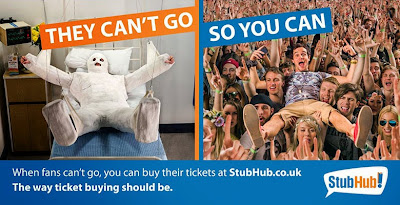
On our commute to the city we are bombarded with adverts promoting miracle anti-wrinkle creams or a cure to male pattern baldness. Usually we never give these ads a second glance, probably because we know better than to believe that such a magic elixir exists (well, not an affordable one anyway!). So how do marketers draw the astute commuter's gaze from their smart phone or free newspaper? A spot of humour and elaboration can do the trick!
Stubhub Advert: "They can't go, so you can"
Stub Hub is a very simple idea; when someone can't make a concert, you can buy their tickets via their website usually at a discounted rate. While the site is highly profitable, trying to communicate such a basic message in an interesting way can be tricky. Even if you have the best website in the world, unless people are aware of it, it's useless. So how did StubHub overcome the simplicity of their marketing message? By throwing a little elaboration and humour into the mix. Firstly, the advert is not a visual display of Stub Hub's desire for someone to be hospitalised so that they would be forced to sell their tickets on StubHub's website (well, I hope not anyway!). The point of the advert is to get your attention while making the marketing message clear and concrete.The ad is clearly designed with tongue firmly in cheek and is a bit far fetched, but has successfully made a straightforward, simple message funny and engaging! Putting out an advert featuring the typical reasons for selling your concert tickets like needing extra cash or having a cold, is either to difficult to communicate in print or too boring. So in this case a slight, humorous elaboration on the truth has worked wonders.
Scimx #Bossit advert The protein shake market is saturated and with a thousand and one different market offerings, it's hard to know which one is the best. In such an environment brands need to look to creative advertising to stand out when their USP or positioning are ineffective. The image above is part of Scimx 's #bossit campaign to promote their new range of health supplements. Demonstrating the functional attributes of its product is nothing new for a sports nutrition company. We have all seen the image of a ripped topless man holding a protein shake in one arm while flexing the other. While all these adverts seem the same, promoting the physical benefits of usage is the best form of advertising for products of this nature. But that does not mean all the adverts have to be predictable or boring.
By Scimx displaying a picture of a destroyed punching bag demonstrates the physical benefits of their product but in a novel way. No one is expecting that after drinking one protein shake they will be able to destroy a punching bag, but the image is certainly a head turner. Men are becoming increasingly immune to the use of the "ideals"of male beauty in adverts. This is because everyone seems to be offering the same thing, a big muscular body. When this happens the "ideal" is no longer associated with one specific product thus diminishing its effect on buying behaviour. In order for advertising to utilise the power of these ideals they need to make them realistically unattainable, yet something to strive for. Having a muscular body is something we can all obtain with the right exercise and diet, but punching your way through a punching bag is something reserved for the Gods. The bait of self improvement can be a powerful tool in marketing when it is used correctly, and this is an excellent example of that.We know that are not likely to ever attain such God- like strength. However, by pairing the aspiration with their product in our heads, Scimx are using "fantasy" to crave out a distinctive position for themselves in the marketplace. Well it certainly got me daydreaming!
After watching the recent TV advert for This Girl Can, I have taken the view that 'This boy also Can' and have been inspired to dust off my running trainers and register my first entry at the gym for 2015. This national campaign is the brainchild of Sports England who want to get women up and down the country doing more exercise, irrespective of sporting ability. My female friends have all said how much they like the adverts or how much more motivated they are to participate in sports as a direct result of seeing the ad. So why is this campaign so successful? Well, without getting too bogged down in all the fancy marketing jargon, I will focus in on two specific marketing communications tools, media advertising and out-of home advertising (TV and posters etc.), to explain why I think the campaign works so well.
Firstly, let's start with the name. Getting the correct brand name or, in this case, campaign title is vital for any marketer who is trying to sell or promote something. So while on the surface This Girl Can might seem very basic, it is also very effective. Not only does it make a great hashtag for social media, it emphasises empowerment and the target market's ability to engage in what is being advertised. Effective brand names should not only be simple and encourage trial of the product or participation, it should also aid in brand awareness. My friends not only picked up the name relatively quickly, but they were also able to recall the name at the drop of a hat. For example, when I would say "I like that funny advert with all the women sweating in the gym', I would receive an immediate reply of "Oh do you mean, This Girl Can ?" from any female in ear shot. The fact that any girl I spoke to and had seen one of the campaign's touch points (oh that's just any message medium capable of reaching customers), proves that apart from the campaign having a good name, it was also able to reach it's target market, all women!
Like any marketing campaign, after deciding 'what' you are advertising, the next port of call is deciding 'who' you are aiming it at. No prizes for guessing that this campaign is gender specific, but normally marketers would go beyond just demographical segmentation (gender) and go after a specific target group within that segment. So while it would seem that Sports England had made a vital marketing error, their lack of specificity was intentional. This fitness campaign is based on, or positioned on, the idea of being inclusive (well for women at least), so the campaign managers would be happy to hear that my friends who all have different fitness levels, can relate to the campaign. But beyond this, any marcom (marketing communications) campaign needs to be integrated, in other words, what you say in one place needs to match what is said or communicated in another. Simple enough concept I know, but you would be amazed how many companies get it wrong. However, the guys over at Sports England have got IMC down to a T (oh, sorry Integrated Marketing Communications).
Ok, I guess what most you guys saw was the TV advert which ran through most of January, so let's examine that first. The advert works so well because it is entertaining, straight forward, but most importantly, it's relatable. If we are completely honest with ourselves we could all do with losing a bit of weight, especially following the festive period when we had one too many...and then one more! But shifting those love handles is not made any easier when you walk into the gym and have to train next what could only be described as Miss Fitness 2015, or in my case, Mr Muscle 2015. All jokes aside, working out in a public gym can be a very daunting experience. The big difference with this campaign is that because it's aimed at all women, it uses 'real' women of all different shapes, sizes, and abilities to communicate its message. Using women who don't possess the picture perfect abs, bums or tums, allows the average women to connect with the ad more easily because she can put herself in their shoes. Put simply, she can recognise one of those body shapes when she looks in the bathroom mirror. This idea of using 'real women' for adverts is something which is becoming more popular as our ideals of beauty change over time. With the banning of size 0 on catwalks and natural curves being embraced by both sexes, this advert is more in step with what is now perceived as being 'normal'. Research undertaken by Unilever, showed that many women didn't believe its products worked because the women shown using them were so unrealistic, hence Dove's real-women campaign. Check out the wallpaper, remember it now?
Watching other women of all ages, to use one of the ad's taglines 'sweating like a pig',hair everywhere and with all their jiggly bits on show, is not only more believable it emphasises the "if she can do it why can't I" affect. And apart from the ads being more relatable, they are also pretty funny. Taglines like the one above ' I jiggle therefore I am' or an image of girl sweating on a exercise bike with 'Damn right I'm hot' plastered across the screen, adds humour to something that that can be seen as quite embarrassing. Marketers will often use humour in order to get their audience's attention, but also to off-set uncomfortable by-products of product use or participation. Some women may have self esteem issues about their bodies or may feel self-conscious working out in public settings. Sports England reduced these anxieties in two ways. Firstly, and one of the oldest tricks in the book, they highlighted the supposed flaw before anyone else could e.g 'look at this horrible spot on my face'. Then by showing loads of women embracing these so called 'imperfections', re-enforces the normality of them and reduces the anxiety surrounding them.
Now to get a little bit more technical, but I think you can cope. This also relates to what sociologists would call the "looking glass self", the process of imagining others' reactions to our behaviour or actions. So rather than just guessing what people think of them when they workout (which is typically negative), this ad allows women to see for themselves. By watching their peers on TV, they can see that "hey its not that bad" and therefore based on their new perception of what other might think when they are working up a sweat up, they are more willing to engage in the activity (see it wasn't that complicated).We are all self-monitors in social environments. By helping to the lower the intensity level of self consciousness in these situations, Sports England have been able to increase female acceptance of their marketing message. Both the campaign's media advertising and out-of home advertising convey the same concrete message to their target audience, but are also prime examples of what advertising agencies would call effective advertising. Effective advertising satisfies five main conditions:
1. It extends from the marketing strategy: Sports England campaign managers wanted an advert to encourage females of all ages and abilities to participate in sport..... check!
2.Effective advertising takes the consumer's view: By using real women and accurately portraying what they go through when working up a sweat, the advert connects with its target audience......check!
3.It finds a unique way to break through the clutter: The fast paced, real-life shots used in these ads (not to mention the humorous taglines), does not fail to catch both the tv watcher's and the passer-by's attention....check!
4.Effective advertising never promises more than they can deliver: Far from promising an easy way to lose weight (quite the opposite in fact) the ad depicts the blood, sweat and tears of working out but still makes it seem fun........check!
5.It prevents the creative idea overwhelming the campaigns marketing objectives: Ladies do more exercise.....check!
But I think the most important thing is that the ad sticks. The worst thing a marketer could do is spend all their time and money making an ad that after two seconds of seeing it you have forgotten what it was about, or worse still, that it exists. But luckily for the marketers over at Sports England their ads are remembered.
This campaign exhibits all the traits of an integrated and well-orchestrated marcom strategy. All the ads speak with a single voice so the message is clear and the hashtag thisgirlcan is a great way to get women involved in the campaign via social media. Nowadays, we as consumers don't just want to sit back and watch marketing campaigns, we like to get involved. This Girl Can campaigners not only want ladies to interact through their social media handles,they also want them to share the fitness stories on the website. This not only re-enforces the core message that any girl 'just like you' can get involved, but also helps to create user-generated 'content' which is a more interesting way for potential participants to learn about the campaign. In short, Sports England's well executed IMC campaign has ensured that the initial marketing objectives of brand awareness and nurturing positive attitudes towards the campaign have been achieved. However, the next step is measuring the success of the campaign in getting more ladies involved in exercise over the next twelve months. I mean it is one thing to say "yeah I should do exercise" its a whole another thing actually doing it.. can I get an Amen!